
 20 October 2026
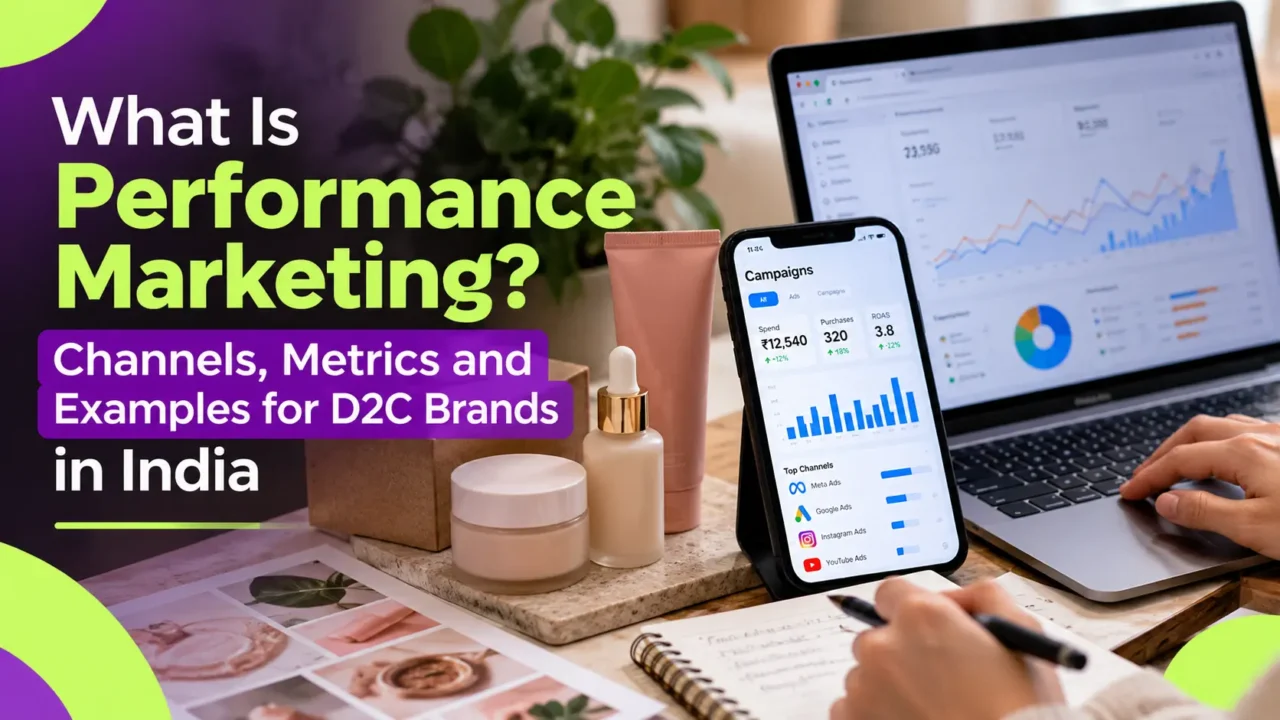
Table of Contents
If you run a D2C brand in India, you’ve probably asked yourself some version of “what is performance marketing and why do my ads still feel like a gamble?” You’re not looking for a textbook meaning — you want to know how to make each rupee bring back more than it cost.
The gap is rarely strategy decks or buzzwords. It’s that campaigns aren’t set up to be measured properly, or budgets are spread across too many channels with no clear target. This guide breaks down how performance marketing actually works for Indian D2C brands, which channels matter, what to track, and where brands usually burn money.
What Is Performance Marketing For D2C Brands?
At its simplest, what is performance marketing for a D2C brand? It’s paid marketing where you only judge success by a measurable action: a purchase, a lead, an app install, sometimes even a WhatsApp chat. You’re not buying “reach” or “awareness”, you’re buying outcomes you can see in your dashboard. The usual performance marketing meaning in agency decks sounds grand, but for a founder it comes down to three questions: how much did we spend, what did we get, and can we repeat it at scale. If you can’t answer those three, you’re not running performance marketing yet, you’re just doing paid promotion.Performance Marketing Vs Digital Marketing
Many founders use both terms interchangeably, but performance marketing vs digital marketing isn’t the same question. Digital is the umbrella: every activity that happens online, from SEO to email to branded content. Performance is the slice of that spend where you can tie cost to a clear result. Think of a typical D2C stack. Your content marketing and organic Instagram feed are digital marketing. Your Meta sales campaigns, Google Search for “buy protein powder online”, and retargeting flows are performance. The mistake Indian brands often make is judging all digital work by performance numbers, then calling good long-term brand work “failed” because it didn’t convert this week.Core Performance Marketing Channels For Indian D2C Brands
Once you’re clear on concepts, the next question is which performance marketing channels to bet on. For most Indian D2C brands under 200 orders a day, the answer isn’t “be everywhere”. It’s to pick two or three channels that match your product price point and sales journey, then go deep.Paid Social: Meta And Instagram
For fashion, beauty, personal care, F&B and impulse purchases under ₹2,000, Meta (Facebook + Instagram) is usually the first serious channel. Good creative, sharp hooks and clean tracking can get you from first touch to order in one or two clicks. Pairing your own ads with creator-led UGC and whitelisted influencer handles, the way performance-focused agencies do, tends to cut acquisition costs faster than new audiences alone.Google Search And Shopping
If your product solves an active problem — “acne safe sunscreen”, “protein powder without sugar”, “ergonomic office chair” — you want Google. People here already know what they want and are comparing options. Search and Shopping campaigns are often where you get your most profitable customers, even if volumes are lower than social.Influencer And Creator Performance Campaigns
Creator campaigns used to be dismissed as “branding”. That’s changed. With unique coupon codes, trackable links and UGC ads, influencers can sit inside your performance plan, not outside it. Agencies like Unikqo connect influencer campaigns with Meta performance for D2C brands so content, audiences and ad spend work together instead of in silos.Marketplaces, Affiliates And Aggregators
If you sell both on your website and on marketplaces, sponsored listings and affiliate deals can behave like performance channels too. The rule here: don’t mix your marketplace P&L with your D2C store numbers. Measure ROAS, repeat rate and contribution separately, or you’ll over-invest where margins quietly vanish.Key Metrics That Actually Matter
Performance marketing throws dozens of metrics at you, but only a few should drive decisions. Chasing everything is how dashboards look impressive while cash flow quietly worsens.Acquisition, Revenue And Profit Metrics
- Customer Acquisition Cost (CAC): Total marketing spend / new customers in that period.
- Return On Ad Spend (ROAS): Revenue from ads / ad spend. Early-stage brands often target 2–3x, then optimise.
- Contribution Margin Per Order: Revenue minus product cost, shipping and discounts. Without this, ROAS is a vanity number.
Funnel And Creative Metrics
- Click-Through Rate (CTR): Low CTR usually means your creative or hook is off, not that the product is bad.
- Cost Per Click (CPC): Helpful when comparing two platforms or audiences targeting the same offer.
- Conversion Rate (CVR): Sessions to orders. If this is below 1–1.5% for D2C, look at your product page and checkout before blaming targeting.
What ‘Good’ Performance Marketing Looks Like In India
Most D2C founders don’t struggle with ideas for campaigns. They struggle with deciding what “good” looks like. Without that, agencies and in-house teams both chase the wrong goals.Channel Mix And Budget Allocation
A healthy starting mix for many D2C brands is 60–70% of paid budget on Meta, 20–30% on Google, and the rest on influencers or experiments. This shifts as you scale and understand payback periods. Aggressive discounting can improve top-line ROAS but destroy contribution, so decide the margin you won’t cross before festival seasons hit.Influencer Examples For D2C Performance
Think of a skincare brand doing 80 orders a day from paid social. Instead of only scaling ad budgets, they identify three mid-tier creators whose audience overlaps tightly with their top buyers, run trackable campaigns, then lift the best-performing content into Meta as UGC ads. This is the kind of approach you’ll see discussed in guides on what influencer marketing means for Indian brands.Common Mistakes Indian Brands Make
- Scaling budgets before stabilising tracking and attribution.
- Running prospecting and remarketing with the same creative and offers.
- Depending only on discount codes to track influencer or affiliate work.
- Ignoring post-purchase journeys and repeat revenue when judging CAC.