
Unikqo

How to Transition from Barter Collabs to Paid Brand Partnerships in 2027

From Barter to Paid Partnerships

Table of Contents

If you are an Indian creator, your early journey likely started with a flood of PR packages and barter collaborations. Barters are great when you are building a portfolio or genuinely need a high-ticket item, but they don’t pay the rent. As we move into 2027, Indian D2C brands are shifting their budgets toward performance-driven influencer marketing and long-term ambassadors. Here is the exact roadmap to stop working for free products and transition to paid brand partnerships.

Key Takeaways

  • Follower count isn’t everything: Brands in 2027 care about ROI, Click-Through Rates (CTR), and Customer Acquisition Cost (CAC).
  • Start with Hybrid Deals: Pitch a “Product + Base Fee” to mid-sized brands to cover production costs.
  • Monetize UGC: Charge licensing fees if a brand wants to use your reels or images for Meta Ads.
  • Pitch Long-Term: Retainer deals (e.g., 3-month partnerships) provide better brand conversions and stable income for you.

1. Recognize When You’ve Outgrown Barter Deals

Before you ask for a paycheck, you need to know if you have the leverage. It is time to transition to paid campaigns if:
  • Your content consistently drives comments asking, “Where can I buy this?”
  • Brands are sending strict creative briefs, multiple revision requests, and tight deadlines for a free product.
  • Your production cost (studio, props, editing time) is higher than the MRP of the product.
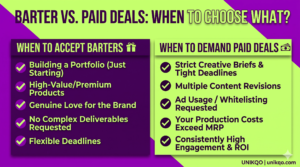
 

When to accept Barters vs When to demand Paid Deals

2. Shift Your Pitch from “Reach” to “Conversions”

In 2027, vanity metrics like follower count don’t guarantee a budget. Brands—especially in the beauty, fashion, and FMCG sectors—care about Customer Acquisition Cost (CAC) and Return on Ad Spend (ROAS). To land paid deals, upgrade your media kit. Instead of just showing your follower count, highlight:
  • Link Click-Through Rates (CTR): How many people swipe up or click the link in your bio?
  • Audience Demographics: Are your followers based in Tier-1 or Tier-2 cities? What is their purchasing power?

3. Introduce the “Hybrid Model” as a Stepping Stone

Going from 100% barter to charging ₹50,000 per Reel can scare off mid-sized D2C brands. The safest transition strategy is the Hybrid Deal (Product + Cash). The “Paid Pushback” Email Template: “Hi [Brand Name] Team, I love the product and would be thrilled to feature it. Due to the high volume of requests and the production quality I maintain, I am currently only taking on paid partnerships. However, I can offer a hybrid rate of [Product] + ₹[Base Production Fee] for 1 Reel and 2 Stories with a clickable link. Let me know if this fits your marketing budget!”

4. Upsell UGC and Meta Ad Usage Rights

Many brands use influencer content as ad creatives for their Meta and Google campaigns because User-Generated Content (UGC) lowers their ad costs. If a brand insists they have “zero budget for a paid post,” offer to shoot content exclusively for their ads.

5. Propose Long-Term Retainers Over One-Off Posts

Trends for 2027 show that one-off influencer posts rarely change buying habits. Brands are looking for long-term ambassadors to build enduring trust. Instead of asking for ₹10,000 for a single post, pitch a 3-month partnership for ₹25,000. It guarantees you consistent income and gives the brand a better ROI.

Scale Your Creator Journey with Unikqo

At Unikqo, we understand the frustration of chasing payments and navigating one-sided barter deals. As a specialized influencer and performance marketing agency, we connect high-performing Indian creators with top-tier D2C brands that are actively investing in paid partnerships and high-quality UGC. If you are a creator ready to monetize your true market value based on data and conversions—or a D2C brand looking for influencers who actually drive sales—it is time to partner with us.

FAQs

What is a barter collaboration in influencer marketing?

A barter collaboration is an exchange where a brand provides free products or services to a creator instead of a monetary fee, in return for agreed-upon social media deliverables.

How many followers do you need to get paid by brands in India?

There is no fixed follower count. Nano and micro-influencers (3,000 – 20,000 followers) can secure paid partnerships if they have a highly engaged niche audience and can drive measurable website clicks.

Should I give brands free ad usage rights on barter content?

No. If a brand wants to use your barter content for paid Facebook or Instagram ads (whitelisting), you should charge a separate licensing fee.

Share:

Write Your Comment